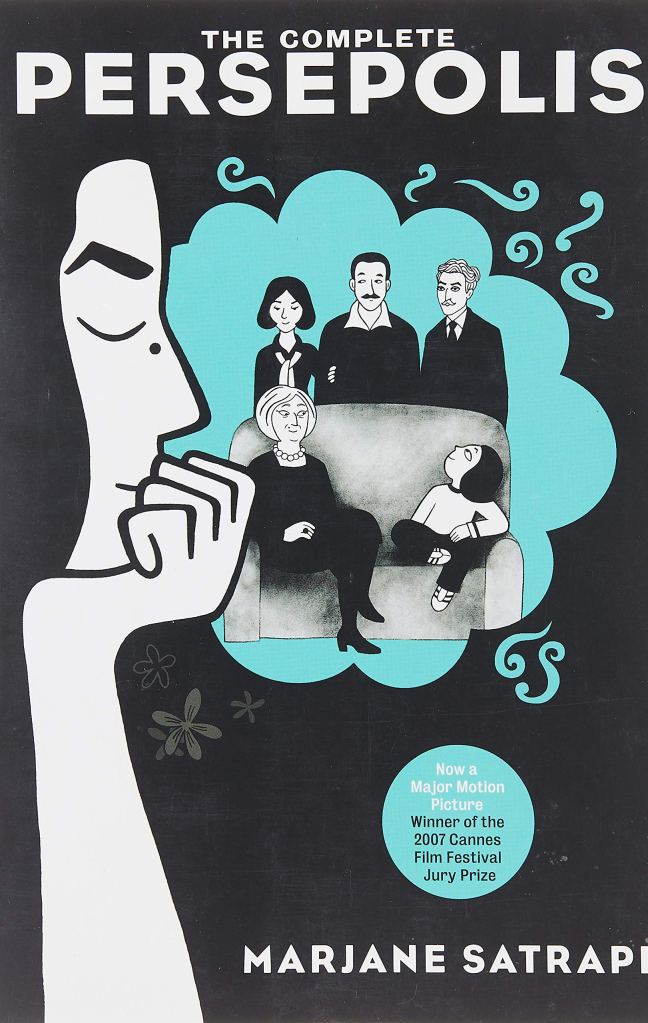
Bibliographic Information:
- Title: The Complete Persepolis
- Author: Marjane Satrapi
- Publisher: Pantheon Books
- Copyright Date: 2003
Genre: Teen, Graphic Novel, Historical, Biographical
Awards or Honors: None
Reading Level: Older teenager and adults
Plot Summary: The book is a memoir of the author, Marjane, as she describes her experiences growing up as a 10-year-old girl in Iran during the 1979 revolution and war. She was a believer in creating the Islamic Republic, overthrowing the Shah leader, and making society fairer. She describes the feelings of the people, the protests, and the violence that took place. She then describes the Iraq-Iran war and the suffering and anger during that time. People died, and supplies were not available. As the years go by in the 1980s, Marjane grows up and is obsessed with Kim Wilde, an English pop singer. She moves to Austria in 1984 without her family to escape war and have a better life. Living in a new country gives her a new identity and experiences. She returns home to Iran and settles back into the country, marrying and getting used to a life different than Austria. However, she realizes she wants to leave Iran, so she gets a divorce and moves to Strasbourg, France, to study graphic design.
Author Background: Marjane Satrapi grew up in Iran during the 1979 revolution. Over the next 15 years, she spent time in Iran and Vienna, Austria, before deciding to move to France, where she now lives. Her parents were Marxists growing up. They instilled in her independence, confidence, and education throughout her life. She grew up with lots of books to read. Satrapi was born in 1969 in Rasht, near the Caspian Sea. She struggled with her identity in Austria and Iran, as she spent time in both societies. She was married for three years in Iran before getting a divorce. She now lives with her Swedish husband in Paris. She first started writing The Complete Persepolis at 29 in 1999 (Confessions of Miss Mischief, 2008).
Critical Evaluation: The comic is in black and white and told from her perspective as a child until adulthood when she decides to move to France. The graphic art is from 2003 and doesn’t have the same details and modern graphic art design today. The black and white colors and autobiographical nature reminds the viewer of Maus. The book is over 300 pages and is long for a graphic novel. However, it gives the reader a chance to pick up details and facts about the main character and her family you might miss in shorter novels. The book is clearly divided into chapter topics that allow the reader to understand the upcoming subject. Some chapters are dark, while others are more joyful. The author uses lots of black to illustrate dangerous scenes. Readers will also get a sense of what Iran was like for a child growing up and a woman who had experiences in Iran and Europe.
Creative Use Library Program: I would use this book to teach about Iran and Middle East politics in school. A class would read the book while learning about Iran and the Middle East from textbooks. The United States has had tension with Iran’s government for decades, and we mostly hear about Iran from a United States perspective. This book provides a perspective of Iran from someone born and raised in Iran. It might help students better understand Iranian history, culture, and society.
Book Talk: Iran has been influenced by many different cultures in its ancient history but has proudly hung onto its traditions. Marjane Satrapi grew up during a turbulent time in Iran’s history, including the 1979 revolution, war with Iraq in the 1980s, during social changes in the 1990s before moving to France. This autobiographical graphic novel shows Iran from a woman who loves the country and the people who live there.
Potential Challenge Issue: Potential challenges might be possible over history and religion mentioned. I would defend the book as an autobiographical look at what life was like in Iran. We need these firsthand accounts of life in Iran to give Americans and Europeans a perspective of Iran not discussed in the West.
Reason for Inclusion: I included this book because it was a historical graphic novel teenagers can learn from while also being entertained. Kids should know about the perspective of countries outside of the United States, particularly of countries often vilified in America. I thought it was an interesting topic that libraries should have information and materials on.
Hattenstone, S. (March 28, 2008). Confessions of Miss Mischief. The Guardian. Retrieved November 22, 2020, from https://www.theguardian.com/film/2008/mar/29/biography
Satrapi, M. (2003). The Complete Persepolis. Pantheon Books.
 INFO 265 Materials For Youths