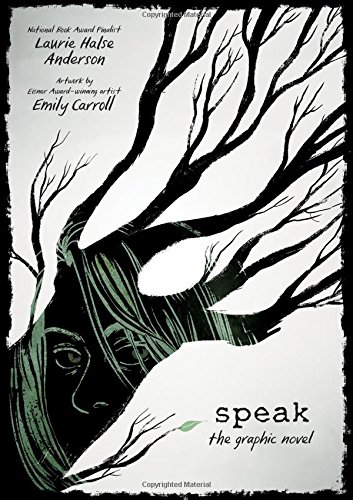
Speak: The Graphic Novel
Bibliographic Information:
- Title: Speak: The Graphic Novel
- Author: Laurie Halse Anderson
- Publisher: Farrar Straus Giroux
- Copyright Date: 2018
Genre: Graphic Novel, Teen
Awards or Honors: A School Library Journal Best Book of 2018
Reading Level: Teenager
Plot Summary: Melinda is a freshman student at Merryweather High School who is an outcast trying to make friends and survive the first days of high school. Her teachers are mean or don’t understand her. All her friends from middle school have abandoned her due to something that happened during the summer. People think she called the cops to bust Kyle’s party. She doesn’t fit into her traditional, conservative school and clashes with her parents, students, and culture. She feels miserable throughout the school year. Her friend Heather is trying to join a popular group of high schoolers, often forgetting about Melinda or disregarding their friendship. She is often anxious about fitting in and what she perceives to be her flaws and awkwardness. It turns out, Melinda was raped at the party before her freshman year by a senior named Andy. She called the police to report the assault, but people think she called the police about the party. People encourage her to speak up and explain everything that has happened to her, but she finds it difficult to do. She tells a girl named Rachel about Andy, causing Andy to find out and attack her in a classroom for telling the truth. After processing everything that happened, she realizes what Andy did wasn’t her fault, and she is a survivor and can move on.
Author Background: Laurie Halse Anderson is the author and wrote the book as a novel in 1999. She has been a New York Times-bestselling author. She has also written a book called chains, which were National Book Award finalists. She has written other books like The Impossible Knife of Memory and Wintergirls. She has been an advocate against censorship and has been honored by the National Coalition Against Censorship and the National Council of Teachers of English for her work (Home, 2020).
Critical Evaluation: This book is an illustrated look at what life can be like in high school when after traumatic events. The book’s themes include PTSD, fitting into high school, friendships, and dealing with trauma. The book is illustrated very well and provides a great insight into Melinda’s emotions and way of feeling. The book illustrations are in black, white, and gray. When someone feels more emotions, or there is a dark or angry scene, it happens in black. The author uses shadows and various shades of gray to cast the main character as alone or struggling. The book is about 300 pages, but the plot is developed well. The other characters are usually portrayed in a bad light against Melinda, but there are a few nice people.
Creative Use Library Program: I would have this book be part of a collection of graphic novels available to get more kids interested in graphic novels. Graphic novels are sometimes viewed as low-brow comic books that are silly or for kids. This book touches on important issues and presents an honest look at high school life and trying to make it through.
Book Talk: Melinda is a freshman in high school, dealing with problems. She has no friends, her parents fight all the time, and everyone thinks she’s a snitch because she called the police while at a party. Life seems to go from bad to worse. As she tries to survive high school, she learns she must stand up speak out to help herself, no matter the results.
Potential Challenge Issue: Potential challenge issues might be issued for discussing rape. I would defend it as a part of the book necessary to understand the character’s thoughts and emotions throughout the book. The issues portrayed in the book are important and should be read. I would talk with my superiors or a school board if there were any issues.
Reason for Inclusion: I included this graphic novel because it is an award-winning book. Having it presented in a graphic novel was an interesting way of examining high school life and dealing with trauma. The book had good illustrations and discussed issues teenagers might be going through.
Anderson, L. (2018). Speak. Farrar Straus Giroux.
Home. (2020). Laurie Halse Anderson. Retrieved November 22, 2020, from https://madwomanintheforest.com/
 INFO 265 Materials For Youths