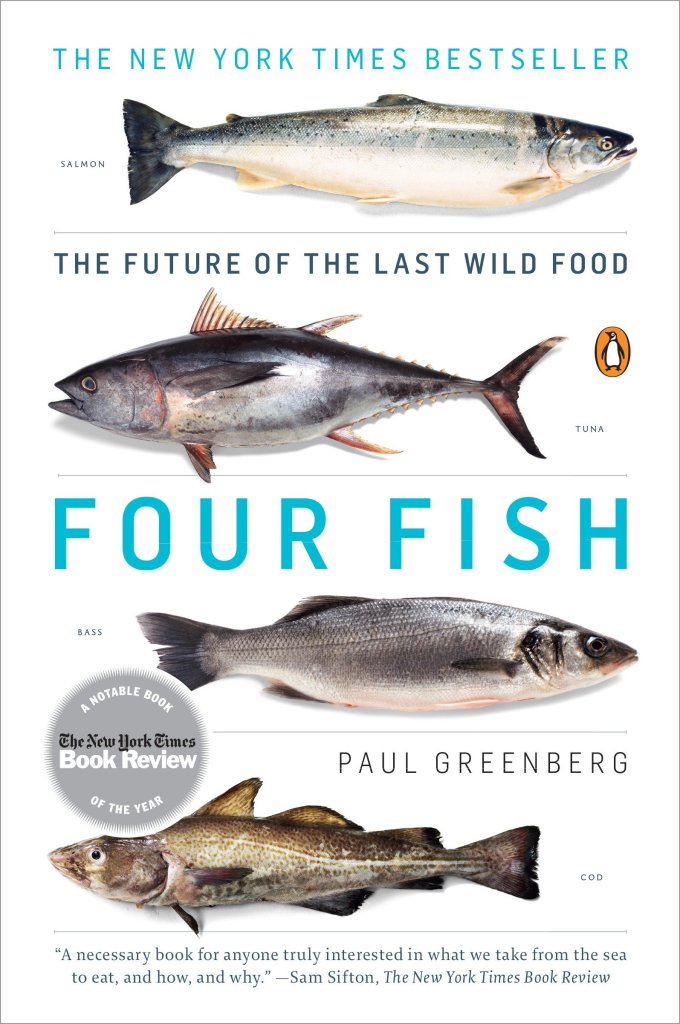
Bibliographic Information:
- Title: Four Fish
- Author: Paul Greenberg
- Publisher: Penguin Books
- Copyright Date: 2010
Genre: Non-fiction, environment
Awards or Honors: A New York Times Bestseller
Reading Level: Teenager
Plot Summary: This book follows the history of four species of fish important to people’s dietary habits and the environment. These four species are salmon, seas bass, cod, and tuna. All four of these species consistently appear in human diets worldwide and are resilient to some aspects of climate change, making them candidates to be stapes of a diet. Paul Greenberg visits the Massachusetts coast, Alaska, and other parts of America to examine fish environmental issues. He also examines farm fish versus wild fish, pollution, plastic in the water affecting fish, and fish population decline. The author also provides a history of the four species and how important they have been to humans in ancient times. The author provides examples that show humans must respect the balance between their wants and the future survival of wild fish. Each chapter also provided examples of how farm fishing isn’t as good for the fish or people as wild fish.
Author Background: Paul Greenberg is an author who has written multiple books about fish. He works at the New York Times and has been awarded the James Beard Award for Writing and Literature. His newspaper work focuses on diets, fish, and food issues. Greenberg said he was influenced by the book Botany of Desire when putting together his book. He did lots of research for the book, including looking at how the fish system works globally. He wanted to write a book to examine the possibility of if humans could create a balance between fishing and giving fish the sea to survive (Greenberg, 2020).
Critical Evaluation: The book is a comprehensive look at major fish species across the globe. Climate change, overfishing, changing fishing practices, and human pollution hurt fish. If things don’t change in the next few decades, many species will permanently disappear. The book presents a clear problem that affects everyone and what can be done to fix it. The writing is engaging and clear and isn’t like a history textbook or convoluted book. Teens will be able to read the book and get an introductory course on an important issue. The book is divided into four sections, one for each fish, making it easier to read and understand the differences between the species.
Creative Use Library Program: I would use this book for a summer program where we go fishing. I would first half us read the book and discuss issues like overfishing, climate change, and human consumption habits. The teens would learn about the importance of the issue. The library would then take the teens to a fishing area to fish and then put the fish back. They can learn about sustainability and the importance of fish in our oceans and waters.
Book Talk: Four species of fish are the building blocks for most human fish-eating habits. Salmon, sea bass, cod, and tuna. These four fish are found worldwide, and humans have tried their best to farm fish or control the supply over the past few decades. But is that best for the fish and humans? The author looks at the domestication and fishing of fish species and better solutions than packing fish into small waters to be our food.
Potential Challenge Issue: There are no challenge issues from the past or currently.
Reason for Inclusion: I included the book because I wanted to include more nonfiction books for teens. Most teens might view nonfiction books as boring textbooks, and I wanted to include a book easier to read but still interesting. The issues will also affect the next generation. They must understand how climate change and humans affect all other animal species around us. We will also suffer if we maintain our current habits without coming up with changes. I thought the book seemed interesting and short enough teens would read it.
Greenberg, P. (2010). Four Fish. Penguin Books.
Why Four Fish?. (2020). Paul Greenberg. Retrieved on December 1, 2020, from https://paulgreenberg.org/why4.html
 INFO 265 Materials For Youths